FEB 21-23, 2014: The Detroit Future Schools Rida Institute

From February 21-23, 2014, the Rida Institute will offer a three day crash-course in re-imagining what is possible within our schools. The question "what is the purpose of education?" frames the Institute, as participants explore the educational theories of Paolo FreireJeff Duncan-AndradeEleanor Duckworth,James Boggs and Grace Lee Boggs and others.

THE RIDA INSTITUTE
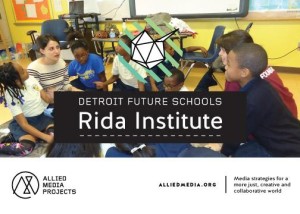
ridainstitute3Are you a K-12 classroom teacher with visions of fostering transformative education in your classroom, but drowning in the day-to-day of federal policies, school bureaucracy and individual student needs?

Do you find yourself asking, "Where do I even begin to fix things?"

Are you someone who works with teachers – either as an administrator, a consultant, or support staff? Do you find yourself wondering where to begin when tasked with helping teachers think through their practice?

Are you looking for a way to reinvent, reenergize, and re-imagine teaching and learning?

The Rida Institute will feature hands-on training and discussion, and plenaries with local and national education specialists.

WHEN: Friday, February 21 - Sunday, February 23, 2014 WHERE: Allied Media Projects | 4126 Third St. | Detroit, MI WHO: K-12 instructors, administrators, support staff

Seats are limited. Click here to apply today!

The deadline to apply is December 15, 2013 January 6, 2013.

Registration ranges from $150 for individuals to $500 for institutions sending a representative. The cost for institutions is used to subsidize the cost for individual teachers paying their own way both locally and nationally.

There are affordable housing options in Detroit. Please indicate your interest viathe application and we will follow-up with your interest with more details.

THE RIDA CLASSROOM

Central to Detroit Future Schools is a unique framework called the DFS Rida Framework that embodies the "action-reflection praxis" articulated by Paolo Freire, and is inspired by the the study of effective practices in urban classrooms, "Gangsta, Wanksta, Rida" by Jeff Duncan-Andrade. As Duncan-Andrade writes in the article, "'Rida' is a popular cultural term that refers to people who can be counted on during times of extreme duress. The term is often referenced in hip-hop with the expression, 'ride or die', meaning that Ridas are people who would sooner die than let their people down." Throughout the article, Duncan-Andrade continues to articulate the "five pillars of effective practice in the Rida's classroom." These pillars include: a critically conscious purpose, duty, preparation, a Socratic sensibility, and trust.

This research and these pillars are what have informed the development of the DFS Rida Institute. The Rida Framework allows participants to gain the type of perspective a Rida teacher would need to authentically serve their students and community. Schools traditionally demand that teachers begin to think about their work by first looking at their content and state standards that are usually far removed from the lived realities of students. As a curriculum development tool, this framework requires that participants first deeply reflect on their contexts and instructional beliefs, demands and goals in order to give school content a critical sense of place and purpose. From this balcony view, participants then articulate practices (action) that will yield desired/outlined outcomes within their classrooms which they will document and evaluate via pre-determined metrics (reflection).

The Rida Framework facilitates participants outlining the following elements as they relate to their teaching:

Context → Purpose → Vision → Principles → Skills → Practices → Content → Metrics

Moving from theory to practice, participants will use the DFS Rida Framework to chart a path towards actualizing transformative education in their own classrooms and schools. DFS defines transformative education as the thing that happens when teachers, students, and school community members are mutually engaged in the work of becoming more fully human. Participants will leave the Rida Institute with the instructional practices, evaluation tools, and network of support necessary to bring this definition to life.

Click here to apply to the DFS Rida Institure!

★ ★ ★ ★ ★ ★ ★ ★ ★

Keep us going and growing: Sign-up to be an AMP sustainer!
COMMENT ON THIS POST ON AMPTALK »

3 New features of Detroit Future Schools for the 2013-2014 School Year

Detroit Future Schools is going into its third year of programming and we could not be more excited! We have learned so much from the past two years of integrating digital media arts into Detroit schools and providing year-long teacher professional development in more than 24 schools across the city. Two things have become clear to us:

1) It is possible to transform classrooms into learning communities that advance our full human potential. 2) The inputs required to make this transformation happen are relatively simple.

DFS has honed a set of instructional practices that when applied consistently have proven to create the conditions in which humanizing education can thrive. We measure humanizing education by the presence or absence of 11 Essential Human Skills within a classroom, such as critical consciousnessmetacognition, and curiosity. We look for these skills in teachers as well as students.

As classrooms are the cells in the body of our school system, we believe that transformation in education at this level has the potential to transform entire schools, and ultimately, the education system as a whole.

As we enter the 2013-2014 school year, we have re-structured our program to have greater impact in a smaller number of schools. We are excited to announce the following new features of Detroit Future Schools:

ANCHOR SCHOOLS

james-and-grace-lee-boggs-schoolIn two years, DFS has been welcomed into 24 schools across the Metro-Detroit area. This year, we made the decision to only work in four schools: The James and Grace Lee Boggs School, Hamtramck High School, Tri-County Educational Center, and Henry Ford Academy: School for Creative Studies.
This decision was made in part because the two-year, non-renewable federal grant under which we launched Detroit Future Schools ended in 2012. While we were successful in securing contracts to continue DFS in six schools, we decided to work only in the four schools where we see potential for long-term partnership. Administrators at all four of these schools deeply understand and appreciate the vision of DFS and will work with us to generate the funds necessary to sustain the program in their schools moving forward.

We look forward to being able to have a more concentrated impact in a smaller number of schools. At the same time, we plan to create more local and national spaces through which to share the lessons emerging from the in-school program. Ultimately, we believe this scaling-down-to-go-deep approach will strengthen the root system of DFS for the long-term.

ZINE AND TOOLKIT

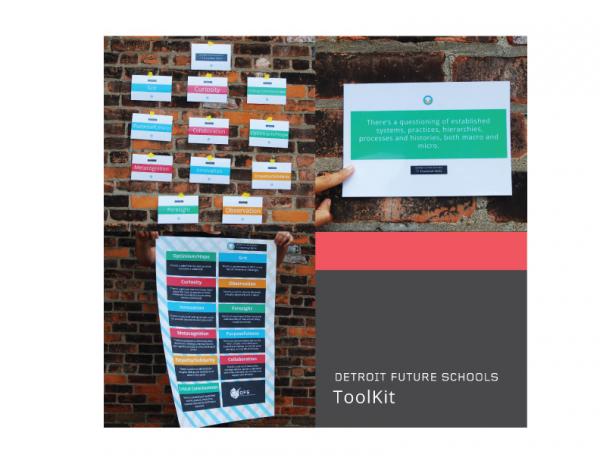
We are committed to an "open source" approach to humanizing education that will allow the maximum number of people to benefit from the practices and ideas that emerge from our anchor schools. Towards this goal, Detroit Future Schools produced a zine that any teacher, youth or artist in schools can use to integrate the spirit and practices of DFS in their own learning space. The zine includes theDFS Vision Statement and theoretical framework, instructional videos, evaluation templates, and lesson plans.

To accompany this zine we created a toolkit of classroom signage that is essential to the implementation of DFS practices. This toolkit includes: an 11 Essential Skills Poster, a Media Project Workflow Poster, Detailed DFS Timeline for the Year. 11 Essential Skills cards, Debate Signs and Rules, Bloom’s Taxonomy, and a Day One DFS Handout.

dfs-toolkit_mockup

RIDA INSTITUTE

For the 2013-2014 school year we will provide more opportunities for educators outside of our Anchor Schools to receive professional development training in DFS core practices.

In February of 2014, DFS will invite educators from across Detroit and the country to participate in the "RIDA Institute" – an intensive three day crash-course in reimagining what is possible within schools. The question “what is the purpose of education?” will frame the institute, as participants explore the educational theories of Paolo Friere, Duncan Andrade, James and Grace Lee Boggs and others.

Moving from theory to practice, RIDA Institute participants will think critically about the specific social and historical contexts in which they work in order to create their own purpose of education statement. From there, they will use the DFS RIDA framework to create visions for their classrooms and the kind of students they will produce. We will share instructional practices for integrating the 11 Essential Skills into classroom content, as well as daily practices for making lesson-planning more efficient and effective.

Participants will have the opportunity to design and refine lesson plans over the course of 3 days, returning to their purpose of education statement to evaluate what instructional practices best allow them to fulfill that purpose. The RIDA Institute will take place in February 2014.

Because space is limited, participants in the institute will be selected through an application process. Enrollment fees will be determined on a sliding scale for individuals and institutions. Contact ammerah@alliedmedia.org for more information.

★ ★ ★ ★ ★ ★ ★ ★ ★

Keep us going and growing: Sign-up to be an AMP sustainer!

COMMENT ON THIS POST ON AMPTALK »

Reflections on the first Detroit Future Schools Network Gathering

On June 20, 2013, Detroit Future Schools organized its first ever Network Gathering as part of the 15th annual Allied Media Conference. Ammerah Saidi, Program Coordinator of DFS, shares her experience.

WHAT DOES IT TAKE TO IMAGINE A NEW WAY OF SCHOOLING?

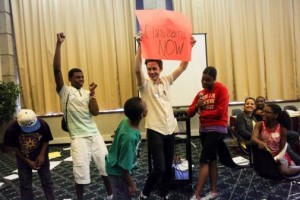
network-gathering-reflections-01-5Detroit Future Schools gathered parents, artists, students, teachers, community members, and youth organizers from across Metro-Detroit in our attempt to answer this question.
Allied Media Project’s theory of change states that we need individuals who can imagine and actualize new realities for a more just, creative and collaborative world.

This is a task much easier said than done. Imagining new realities requires a cognitive skillset that is not currently nurtured in our school systems. Schools are dominantly places where information and "knowledge" is frozen in time, meant to be memorized and then regurgitated in written form through state mandated tests. The implications of this truth should be horrifying. Without our ability to see beyond our current experiences and circumstances, how can humans ever hope to dismantle the complex systems of oppression that shape our world? How can we rise above the walls of our present day to see what’s possible in the future and decide what we want our futures to become?

However, as a teacher and citizen of the world, I can sleep at night. Why? Because one truth will never be obliterated: humans are born curious and imaginative. It’s written into our DNA. I see my niece exploring her world – touching and tasting her way around a maze that from her eyes seems unnavigable. I see her twisting and turning her body in ways that she’s never seen before in order to get out of her crib or off a dresser or through a hole she most definitely should not be anywhere near in the first place. Her fearlessness and innovation is the truth I carry with me as I enter school after school where dehumanizing education practices are the norm. Instead of teaching to the test, we need schools that will "teach to our humanity." This is a call that Detroit philosopher-activist Grace Lee Boggs has been making for decades. We’re excited that the James and Grace Lee Boggs School is opening this Fall and will begin modeling what this looks like on a school-wide scale.

GROWING THE DETROIT FUTURE SCHOOLS NETWORK AT THE AMC

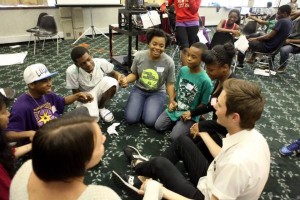
network-gathering-reflections-02At Detroit Future Schools, we are working to prove that teaching to our humanity in our education system as a whole is both pragmatic and revolutionary. We are teaching and learning in ways that foster curiosity and critical thinking, so that schools can become places where students and teachers want to be instead of places they fear not to be – or worse, are legally mandated to be. Over the past two years we have grown a local network of students, teachers, and artists in Detroit who are doing this work in classrooms across the city. We have also grown a national network of supporters and allies. This local-national network made our first gathering possible by contributing $4,350 in 25 days to our Indiegogo campaign.
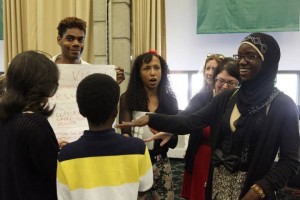
The goal of our first-ever Network Gathering, held in conjunction with the Allied Media Conference, was to bring together all of the major stakeholders from DFS to reflect on the work we accomplished over the past year, build community, and envision the future of the program. Our day together on June 20 yielded intergenerational moments of collaboration and innovation that I have yet to see consistently in our schools. It began with an icebreaker that found second graders talking to high schoolers about what they believe are possible solutions to problems within schools. Then, youth from our sister organizations, Detroit Future Youth and Detroit Minds and Hearts gave presentations on what kind of programming they’ve been a part of that effectively elevates youth agency and voice. The last half of the day consisted of caucuses and action-planning in cross-generational groups. Rather than dry report-backs, we generated songs, plays and a graphic comic strip to express our ideas for how schools could be better. Our network literally imagined new realities and actualized them in real-time through the arts.

network-gathering-reflections-03Our day together was far from perfect and our work is far from done but what I take away from this Network Gathering is the optimism, hope and grit it takes to actualize the world we want to see. I want to have students walk out of classrooms saying what I heard students saying at the end of our time together: "Thank you for this opportunity to speak with adults about school" and "this was one of the best days of my life." I want to see singing, drawing and beat-making infused into our core content areas in schools and not reserved for electives.
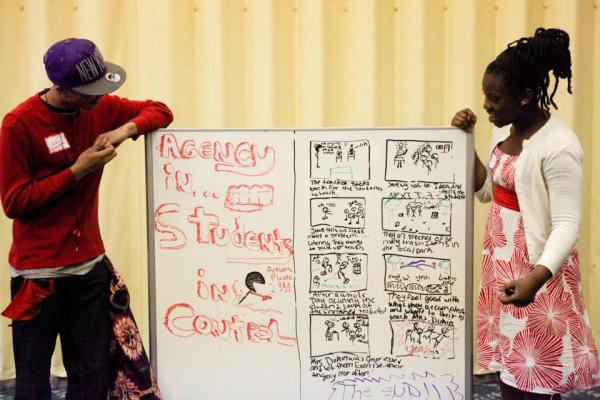
As we gear-up for the coming school year we will be applying many of the ideas that came out of our Network Gathering. As importantly, we’ll be drawing from the muscle memory of what it looked, felt, and sounded like to create the kind of learning we want and need. True to that Ghandian rule of thumb people love to plaster as email signatures or t-shirt slogans, but rarely have the courage to enact – in room Hilberry B & C on Wayne State’s campus, DFS became the change that we want to see in our schools – and eventually the world. This youth-created videofrom our day offers a glimpse of what this looked like. Thank you to all who made the first-ever DFS Network Gathering so incredible.

network-gathering-reflections-04

COMMENT ON THIS POST ON AMPTALK »