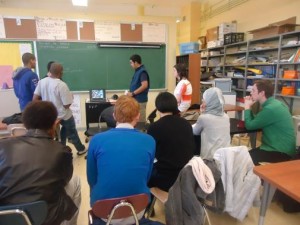
Reflections on DFS' transformative Education Tour of NYC

NYC-tour-reflectionsTeachers and artists-in-residence from AMP’s Detroit Future Schools program recently traveled to New York City to tour peer organizations who are using media for transformative education. The goal of the trip was to explore models of media arts-integration, participatory action research, and youth-leadership development that could be applied to our work in Detroit. DFS 8th grade algebra teacher, Helen Lee, shares her reflections:

I appreciated the opportunity to reflect on our work and the challenges we face in Detroit, while exchanging lessons with organizers and educators in New York.

Our visits were tightly packed yet at every site, we felt a huge space open to our questions and mutual sharing.

We visited the office of the Center for Urban Pedagogy, an organization that partners high school students with community organizations to design educational tools that demystify the complicated policies that directly impact their communities.

We dropped by the Global Action Project to observe Youth Breaking Bordersprogram – an intersection of media making, political education, and youth development.

We met with Jack Martin, associate director of Global Kids' Online Leadership Program. We learned about their process of digital media education that prepares youth to not only access and navigate the digital world, but build their own digital spaces.

To round the trip out, we sat down at CUNY with collaborators of the Public Science Project who have been merging participatory action research and community media to leverage decision-making power in political processes with those who are traditionally left out of the conversation.

On my own, I had arranged a site visit of a school that had piqued my interest. Pam Sporn, a documentary storyteller at Grito Productions welcomed Danielle Filipiak (a DFS teacher alum) and I to the Fannie Lou Hamer Freedom High Schoolwhere she has taught media production to youth. On this visit, we observed the inner-workings of the school and engaged in dialogue with almost everyone who crossed our paths – administrators, students, new teachers, founding teachers, program coordinators, and support staff. In every conversation, I found myself connecting more and more dots. I began to see the work Detroit Future Schools does within a larger web of work taking place across the country to create a paradigm shift in education.

From the many organizations we visited, I distilled some common threads that tie our work together, and lessons that can make our work stronger:

Changing our relationship to media changes our relationship to the world. Sonya, a senior at Fannie Lou, shared with me how much her participation in Fannie Lou TV, the after school media club, shaped her perspective on the imapct of media on public opinion and motivated her to attend a post-secondary institution for public broadcasting. "I realized through this process what is not shown to us in the media and the power of people who control media. By participating in FLTV the power was shifted into our hands and we could choose to present what we wanted about our community and ideas."

A student at the Buschwick Academy of Urban Planning, who worked with CUP to investigate the fad and fascination of micro-apartments in their city, told me how the project exposed him to ideas and policies he would have never thought about had the program not existed in his school. He also shared that the immersion in the research process and the opportunities to connect to a network beyond his neighborhood sparked his interest in continuing to learn about housing policies in his city.

Facilitative leadership is key. While many programs offer youth leadership development, too often we are developing youth leaders to replicate broken forms of leadership. However, in all of the programs we visited, we saw how the purpose of leadership is to build leadership in others.

At Global Kids, students learn game design as well as how to teach others how to design games, becoming curators and facilitators of knowledge. The theory of change at Global Action Project recognizes that true liberation exists when a culture of collective process exists. At this organization, which predominantly works outside schools or after school, youth co-plan and co-facilitate sessions for other youth. By providing a space for youth to authentically become integral agents of change, they are able to take on these leadership roles. Program Director Christian stated, "It's amazing what the human imagination can do when it's challenged to think of something differently."

Relevancy matters. This is only my third year of teaching but I am realizing more and more the lack of relevancy in what is learned in schools. What I really value in the organizations and schools that I visited was the emphasis on learning and action around issues that were directly connected to the community.

An educator at Fannie Lou Hamer Freedom High School, Amanda, shared with me how real world learning experiences not only pushed students to lead their own learning but to also think about the big picture. At Fannie Lou, students are alternatively assessed by their portfolio on three of the core subjects instead of by the New York State Regents. Amanda told me that this structure of relevant evaluation has helped her discover what it means to teach. "Everything I am doing now is more intentional," she stated.

At Public Science Project, participants are pushed to conduct research around their community. In doing so, participants are empowered to produce new knowledge as opposed to remaining only consumers of information.

I am only beginning to wrap my mind around all of the work I was exposed to over my short trip in NYC. I am grateful to have had the experience to connect with and observe others around this work as it has reminded me that there is still more work to be done.
COMMENT ON THIS POST ON AMPTALK »

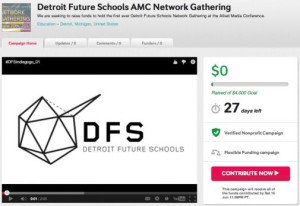
Help Build the Detroit Future Schools Network at the AMC

dfs-indiegogoSupport the growing Detroit Future Schools network by making a donation to the first-ever DFS Network Gathering, Thursday, June 20 in conjunction with the 2013Allied Media Conference. The state of crisis in Detroit's education system is well-known. Yet the work for transformative education within classrooms all over the city, despite the many levels of systemic failure, remains largely invisible.

Detroit Future Schools is making that work stronger and more visible by weaving a network of teachers and digital media artists who are committed to reinventing the purpose and practice of education in Detroit. In DFS classrooms, education is a process that prepares youth and adults to envision and actualize a more just, creative, and collaborative world.

Read some reflections from the 2013-2014 school year on how Detroit Future Schools is using digital media arts to foster metacognitioncuriosity, and critical consciousness in students-- from 2nd grade to 12th grade. Seeing this work in action led one local journalist to conclude, "It was evident that the students I met were in the process of developing valuable technology skills, of course, but also extraordinarily sharp analytical skills and a powerful sense of their individual ability to investigate, understand, and change their communities."

While the Network Gathering is primarily for youth, we are making a limited number of seats available to adult allies within the field of transformative education. These seats will be offered as "perks" for donations of $250 and higher. As an adult ally participant in the Network Gathering you will have the chance to:

  • learn directly from DFS students and teachers about the current state of education in Detroit
  • experience DFS core practices for fostering authentic student leadership in the classroom
  • witness student media projects that grew out of the DFS model for digital media arts-integration with core content.
  • learn about new models for participatory documentation and evaluation, such as the DFS 11 Essential Traits Rubric.

Our goal is to raise $4,000 by June 15, in order to cover food and conference registration costs for DFS students, teachers, parents and community members.

Watch this awesome video to learn more!

Share the link for our IndieGoGo Campaign on social media!


DONATE TO THE DFS CAMPAIGN »

COMMENT ON THIS POST ON AMPTALK »

DFS Classroom Visit: "Thinking about your thinking!"

metacognition_fishbowl"Thinking about your thinking!" This is what the 5th graders in Allie Gross’s Detroit Future Schools classroom at Plymouth Educational Center yell back in unison, in response to the question, "What does metacognition mean?"

This is not because the definition has been drilled into them through rote memorization.  Rather, it is because Allie has built a strong culture of "thinking about your thinking" in her classroom over the course of the school year, with support from DFS artist-in-residence Conja Wright.

AMP’s Detroit Future Schools program is a year-long digital media artist-in-residence and teacher professional development program. Its goal is to prepare Detroit area youth to envision and actualize a more just, creative, and collaborative world.  We look for 11 Essential Traits of Habit, Character and Mind in students, teachers and artists to measure our progress towards this goal. Metacognition is one of those traits.

After observing Allie’s classroom for two hours, I saw how integral this trait is to all of the other Essential Traits.  When students take ownership over their own knowledge, they lay the foundation for self-determination; they are able to reflect on not only their actions, but the thought processes that guide those actions, ultimately giving them more power to determine for themselves who they will be in the world.

Allie is clear about who she expects her students to be in the world: people who will change the world by first changing themselves. The students lead each other in a call and response chant every day:

Be the what? Be the change! Change the what? Change ourselves! Change the what? Change the class! Change the what? Change the world!

As the DFS artist-in-residence, Conja Wright reinforces the classroom culture of metacognition and self-transformation through the integration of media arts.  Since the beginning of the school year, Conja, a librarian and professional storyteller, has immersed students in the idea that they can be authors, not simply characters within the story of their lives and their worlds.

During the first quarter of the year, Conja read and analyzed creation myths from a variety of cultures with the students.  Throughout the rest of the year, she is helping students build the skills they need to tell their own stories about who they are, what their relationship to their environments is, and what it means to be a "changemaker."

The role storytelling plays in changing the world is no simple matter.  It triggers questions like, who has the power to tell stories? How do stories gain power? What is the responsibility of storytellers? Neither Allie nor Conja are interested in pretending that it is, just because their students happen to be 5th graders. They embrace the complexity of these questions and use them to build the metacognition their students need.

On the day that I visited the class they were grappling with the question, "to shoot a photo or to help: what’s the most effective way to change the world?"  The week before, they had analyzed a photo of a woman who had been shot by the police in Haiti, after stealing some chairs.  In the photograph she’s laying on the ground, surrounded by a ring of photographers.

The question of "to shoot a photo or to help" had germinated even earlier in the year, during a "changemakers event," in which the class spent the day cleaning up a park in their neighborhood.  That day, Conja worked with a team of students to photograph the clean-up.  This documentation effort had raised a question around the value of doing changemaking work versus telling the story of changemaking.

The students drew upon these past experiences, as they launched into a "Fishbowl" conversation on the topis.  A "Fishbowl" is a standard DFS practice for structuring an equitable conversation.  The conversation begins with a small group of chairs in the middle, with the rest of the class observing.  After the conversation has gotten going, any student on the outside can "tap" themselves into one of the chairs by tapping one of the other students out.

Allie began by reviewing the rules of the Fishbowl with the students. These include things like, "use evidence," "engage in conversation, don’t just try to convince people of your opinion," "seek a common vocabulary."  The Fishbowl starts, and Allie transcribes the whole thing, with as much accuracy as possible. She doesn’t participate in the conversation at all–it’s entirely the responsibility of the students to self-facilitate, another core DFS practice.

Below are excerpts from their conversation:

"I’m going to start by defining effective.  ‘Effective’ means when we clean up the park.  It’s effective because we’re doing something with the community.  But it’s more effective to shoot a picture than to help, because then a lot of people can see it."

"I disagree with Kamaree and Danielle, because if you help, then the person you help can spread the word and so can you, and then people can know more about the problem through the person that helps."

"I want to ask Daniel a question—why wouldn’t you do both?"

"If you took a picture you wouldn't have enough time to help…"

"I disagree with Daniel, if you take a picture and put it on the Internet millions of people can see it."

"A lot of people can’t afford to get on the Internet!"

"What if they don't like the Internet?"

"Usually some people… I’ll let Nya go. I’ll finish my point after."

"Can we get back on topic?"

"First, I want to say something about the real question…. I would want to take a picture. If you take pictures more people will know. I understand what Daniel is talking about with people not having computers but instead of talking about problems, what about solutions? Like making flyers instead."

The Fishbowl discussion lasts for about 10 minutes.  Allie calls everyone back to their seats and they begin to analyze the transcript together.  She asks the class, "do you think this was a strong or weak Fishbowl? Why or why not?"

"I really think it was slightly good because first we started off talking about the topic, but then we got a little off because we got mad about Daniel’s answer… then people started yelling and they weren’t taking turns."

"I think this fishbowl was all right.. I only think we had issues with transitioning, but otherwise I noticed Nadia, Daniel, Bronson were tracking and asking questions… I think it’s good we figured it out."

After discussing what went well and what could have gone better, they set goals for a second Fishbowl: do better at providing evidence, stay on topic, people on the outside should do a better job of "tracking" the conversation.  They also add two sub-questions to the topic: "what source would you use to spread the word?" and "what does change the world mean?" Here are some excerpts from the second Fishbowl:

"I think they should do both, like Niyah said, in the picture of the woman who was shot I saw all the photographers trying to get the best picture so they could get photography awards. I don't think it’s right. They could have taken her to the hospital."

"Why did they shoot her instead of arresting her just because she stole? Some criminals steal more."

"It could have not just been that she stole the chairs while the police tried to take her away. She could have assaulted an officer. You wouldn't kill someone for stealing chairs, there are more valuable things in the world."

"I want to hear from Elijah."

"you shouldn’t get shot for stealing something."

"I was going to ask, why did she steal the chairs? Did she need it?"

"I’m sorry for cutting you off but Ms. Gross just said stay on topic."

"Did anyone think they could put it on the Internet? Someone could start a protest or something, like when the kids heard that the school was going to close and they protested for it to stay open."

"Actually I think he made a good point, he made a text-to-world connection… how one text is like another… and I think you should do both because actually if I had to choose I would do both, Because the police should get bad guys but they were the bad guys."

"I changed my mind, people can effect change by putting it on the internet, then people can start a protest, like the protest where the kids walked out of class to get their point across."

After the second Fishbowl ends, they do another transcript-analysis.  This time they focus on two questions: what was strong or weak about the process of our Fishbowl?  and what was strong or weak about the content?  The students conclude that the process of this Fishbowl was worse than the first one because there were more people walking around the room, causing distractions.  Then they turn to me and ask my opinion.  I tell them that think the content was noticeably better because they got to what I saw was the heart of the issue: what does it actually mean to change the world?

Then they ask me what I’m planning to do with the story that I’m writing about their class.  I tell them that  I’m going to put it on the Internet so that other people can learn about the work they’re doing in their classroom to change themselves to change the world.  But then I start to wonder, is that the most effective way to change the world?  They’ve got me thinking about my thinking...

Written by Jenny Lee.

Read previous DFS classroom visit blog posts exploring Curiosity and Critical Consciousness.

COMMENT ON THIS POST ON AMPTALK »