

 One of Detroit Future Schools' 11 Essential Traits of Mind, Habit and Character is "critical consciousness." We define critical consciousness as a process of "questioning established systems, practices, hierarchies, processes and histories, both macro and micro."
We work to foster this trait in all DFS program participants, including: teachers, students, artists and program coordinators.
One of Detroit Future Schools' 11 Essential Traits of Mind, Habit and Character is "critical consciousness." We define critical consciousness as a process of "questioning established systems, practices, hierarchies, processes and histories, both macro and micro."
We work to foster this trait in all DFS program participants, including: teachers, students, artists and program coordinators.
As part of the DFS professional development training, teachers reflect on their established patterns of instruction and how they are or are not fostering the 11 Essential Traits in their classrooms. They identify which traits need the most growth and then work closely with a teaching artist to design ways of using digital media arts in the classroom to support that growth.
At the start of the 2012-2013 school year, one of our 12 DFS classrooms decided to make critical consciousness the focus of their first semester. Patrick Butler is a drama instructor at Western International High School and Bobby Colombo is a DFS Digital Media Teaching Artist.
Below are their reflections on how they evolved one of Patrick’s established lessons to better foster critical consciousness, using digital media arts.
PATRICK BUTLER, DRAMA INSTRUCTOR:
A typical assignment for my beginning drama students is to write a eulogy. Students write and perform an informal, 60-90 second introduction speech, then watch videos of well-known orators like Malcolm X, Martin Luther King, Robert and John Kennedy, even Richard Nixon, and discuss what makes a speech successful. One of the videos I show is Robert Kennedy's moving speech delivered upon hearing the news of Martin Luther King's assassination. While not technically a eulogy, Kennedy's words of praise and respect can easily be seen as a fitting tribute to a great American leader, and are the precursor of an actual eulogy. The class then discusses and defines what a eulogy is, as well as when and why eulogies are given.
The next part of the assignment is for each student to write a eulogy about a fictional character. This allows the student to get creative in regard to character choice, and how or why the character met his/her demise. The students then perform these eulogies as if they were actually at a funeral or wake.
This year, while thinking about the socially conscious goals of DFS, we came up with the idea of having the students write a second eulogy, this time "mourning" the loss of an aspect of life in Detroit that most of us would like to see gone. First the class spent time brainstorming, and we made a list of societal ills that we would like to see dead and buried. Abandoned houses, hunger and racism were some of the most popular ideas, and students wrote and performed each eulogy, explaining how our society would be better off with each problem gone for good.
BOBBY COLOMBO, DIGITAL MEDIA TEACHING ARTIST:
With my assistance, we recorded the students performing their pieces. Students worked in pairs using Audacity (free audio editing software) to cut and splice their classmates' individual eulogies into new, original audio pieces with a collective voice. After they finished these audio pieces, they used iMovie to make video slideshows, putting images corresponding to their new eulogy underneath the audio. This helped build another DFS Essential Trait: collaboration.
This lesson demonstrates how long-time teachers can make simple changes to their instructional practices in order to cultivate the 11 Essential Traits of Habit, Character and Mind in their classrooms. It also shows how digital media arts provide a powerful vehicle through which to do this.
You can view a sample from the eulogy video project here.
 We are excited to invite all teachers to apply for one of the most transformative and effective professional development opportunities of a lifetime.
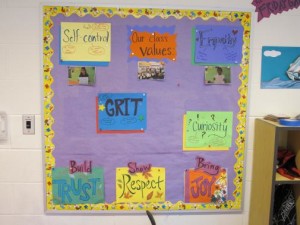 Every week,
 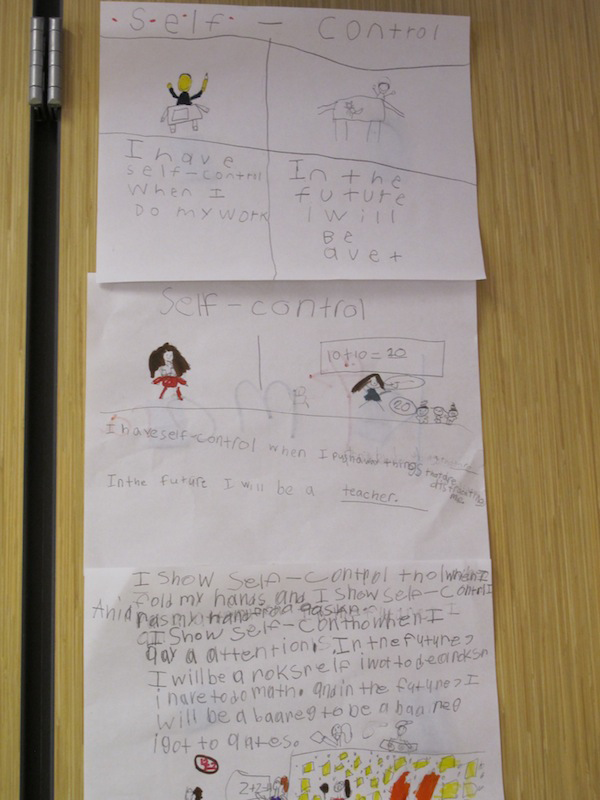 Mr. Joe, as he is known to the students, began the class by asking students to recap what they learned the previous week and to brainstorm what the definition of curiosity was. Students chattered their thoughts in response to these questions until Ms. MB said "I'm noticing a lot of side-talking. You know what to do if you have something to say." She makes the gesture of covering her mouth with one hand while raising the other one. This hand signal is one part of an elaborate system of active listening practices that Ms. MB has built into her classroom. Students helped develop some of the hand signals and regularly use them with each other, effectively distributing classroom management to the students themselves.
 This happened again later in the lesson, when two students pulled out a book and started reading together, while a third was trying to convey a point to the whole class. A fourth student intervened to ask why the two had started reading a book, rather than paying attention to their fellow classmate. One of them explained honestly, "he was taking too long to talk and I got bored so I took out my book." The other added, "I was curious about what she was reading, and wanted to read too." Mr. Joe thanked the students for their explanations and used the scenario to return to the point, that self-control and curiosity can sometimes work at odds with each other, even though they are both positive things.
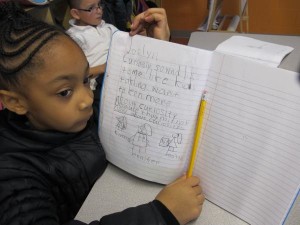 As a college-educated, full-grown adult observer of this classroom, I puzzled over the question, struggling to come up with an answer and trying to imagine how second graders would be able to answer this question. Meanwhile, the students wrote or drew their answers eagerly in their journals. When the time came to share their work, each table of students was tasked with deciding who at their table should present first. They negotiated this for a while, saying things like, "Deven went first last time, so he shouldn’t go first this time" or "Khaliyah hasn’t spoken much today, maybe she should go." Noticeably, the students who had the biggest personalities exercised their leadership by directing these conversations, rather than vying for the chance to go first.