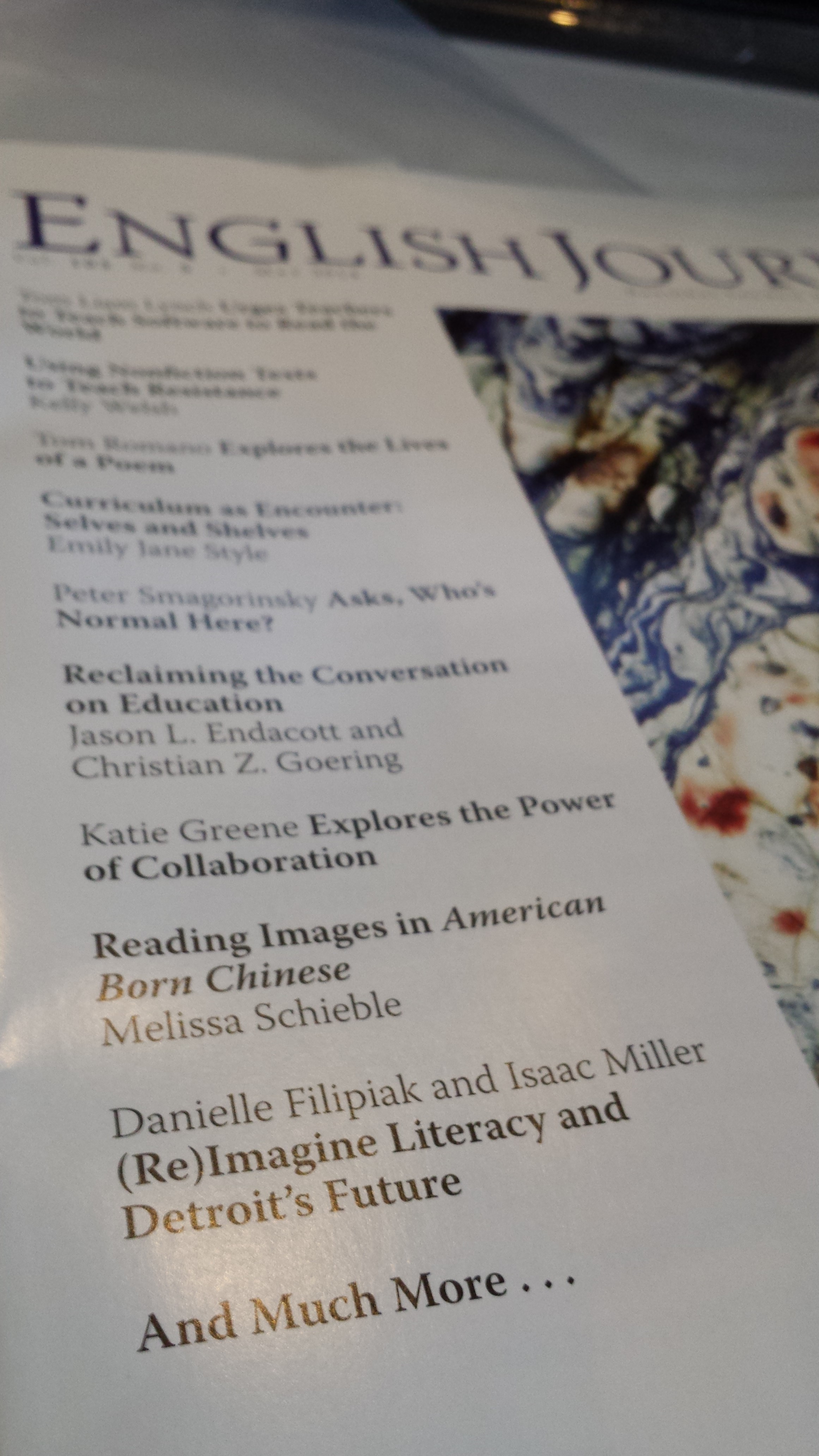
“Me and the D: (Re)Imagining Literacy and Detroit’s Future.”

How can we use digital media, literature, and investigations of our communities to help us rewrite our stories and roles within the world?

Detroit Progressive Ed Conference_01

Danielle Filipiak and Isaac Miller not only asked such a question, but also designed a whole curriculum for their 150 Detroit students in Western High School so as to investigate the question amongst many others relating to identity, place and power.  And better yet, they documented and analyzed their process and findings and published them  in their English Journal cover piece, “Me and the D: (Re)Imagining Literacy and Detroit’s Future.”

20140506_120016 (1)

As outlined in the Detroit Future Schools Toolkit, we believe that a humanizing classroom requires the integration of four core instructional elements:

1.Critical Pedagogy 2.Documentation & Evaluation 3.Community-School Interactions 4.Digital Media Arts Integration

 Danielle and Isaac do a phenomenal job of detailing how they not only made the core ELA curriculum relevant to their students but also integrated all four of the above elements into their practice.


For teachers asking how to engage students in rigorous content while prioritizing a humanizing practice,  this piece is a perfect starting point.


The Classroom is Yours: Practices for self-governance

MAY 19, 2014

This is the second part in a series of blog posts highlighting lessons emerging from Detroit Future Schools. Detroit Future Schools is an AMP Sponsored Project.

Detroit Future Schools' goal is to make our work to humanize schooling in Detroit "open-source" and accessible to other educators. Below, Nate Mullen, DFS Lead Artist, reflects on student-facilitated debates as a practice of self-governance.

DFS is currently seeking individual sustainers to help keep the work going. Click here to sign up!

"YOU CAN'T CHANGE THE WORLD IF YOU CAN'T CHANGE YOURSELF"

– 9th grade Davis Aerospace Technical High School student during a classroom debate

In DFS classrooms, students and teachers work together to connect knowledge to power and take constructive action. This is a sharp deviation from the traditional classroom structure, described by Paulo Freire as a "banking" model. In a banking model of education, teachers deposit packaged commodities of information into students and students, in turn, spit this information back out. Within this transaction the most important skill-set for both the student and the teacher is obedience: the student must obey the teacher and the teacher must obey the curriculum.

Through the past three years of DFS we've learned that the challenge of breaking away from the banking model of education is enormous; one of the primary reasons for this is the fact that we, as teachers and other adults working in schools, are products of the same system we are trying to subvert. If we want our students to be critically thinking, self-governing individuals, we have to grow those capacities within ourselves. Our classrooms must foster mutual transformation between students and teachers.

DFS developed the "root practice" of student self-facilitated debates to do just that. We call it a root practice because we have seen it thrive in multiple contexts – from third grade classrooms to college classrooms and within any academic subject.

HOW THE DEBATE WORKS

The instructor writes a statement at the front of the class. Four signs are posted on the walls around the room that say: Agree, Disagree, Strongly Agree, and Strongly Disagree. Students are given a time limit by which to choose their position and explain their choice. Throughout the course of the debate, students are free to change their position at anytime, if they are swayed by their peers' arguments. The purpose of the debate is to seek the truth rather than to be "right." The instructor remains silent throughout the debate. Their role is to keep time and document the debate. "This is practice for self-governance," I always tell my students before we start. My last words before handing over the classroom to the students are always, "the classroom is yours."

The purpose of debates in DFS is to make learning transformational as opposed to transactional. In order to be effective they must be repeated over and over again, even to the great discomfort of all involved-- including, and especially, the instructor. At first, they can produce total chaos. Over time, they reveal the tremendous capacity for self-governance that is latent within all of us, but which we systematically undermine through traditional schooling practices.

DEBATE THE STATEMENT: "WE ARE THE GREATEST 7TH GRADERS EVER."

This is a snapshot of what the process of transformative education looked like during the first three months of the school year in one of my 7th grade science classes:

During my first visit to the classroom in September I introduce myself and tell the students we are going to have a DFS debate. The students have 30 seconds to debate the statement, "we are the greatest 7th graders ever." At first, the students timidly test boundaries saying, "is he really going to let us say anything we want?" then they spend the whole debate yelling things like, "I'm in this class! so its the best class!"

That's why the first debate is 30 seconds. We debrief the debate and strategize ways to improve it, including the creation of ground rules, to which we will all adhere during the debate. We try it again, a couple more times that day.

"I AM MORE POWERFUL WHEN I AM MORE INDEPENDENT"

Fast forward several months: we haven't done a debate since my first day of class, but I've written at the front of the room under the "Do Now" instructions, "3 minute debate of the statement: 'I am more powerful when I am more independent' NOTE: Once you finish writing these instructions, please take your debate positions."

Two minutes go by and most of the students have written the instructions in their notebooks. I stand at the front of class, beside the board, and wait. Two minutes later, the students notice me waiting. This creates tension because in a traditional classroom the teacher commands and the students obey, but here they are waiting for me and I am waiting for them.

This simple act, of purposefully waiting in front of a classroom of 7th graders, while they all look at me, waiting for my instructions, is strenuous. As I wait, I do not know if the students will take their debate positions. They may have forgotten how the debate works, they may not feel comfortable to leave their seats, but I must wait and be vulnerable. As a teacher, I ask my students to trust me and step out of their comfort zones all the time. Now the tables have turned and it's my turn to trust the students in this process.

After five minutes, the students are becoming impatient. One student pipes up and says, "what are we supposed to do? I did my 'Do Now'." In banking education, students are passive and depend on the teacher as the actor in the classroom. We as teachers play into this system by not allowing for this uncomfortable space to exist – we see this space as a sign of our failure, rather than an opening for students to access their power and agency within the classroom. In this case, my students have written the instructions, but are not applying that information to action, so I continue to wait.

After six minutes, I break my silence. I ask the students to read what they wrote. One face lights up, "Oh!" they stand up, take their debate position, then another and another. This is a moment educators dream about – an idea that literally moves a student across the room.

30 seconds later, all of the students are out of their seats and in their positions. I nod and finally address the class. "Now we are ready to start". I prepare to transcribe and keep time, I wait for the classroom to be silent and then I turn the classroom over saying, "the classroom is yours."

★ ★ ★ ★ ★ ★ ★ ★ ★

Like Detroit Future Schools on Facebook and follow on Twitter.
COMMENT ON THIS POST ON AMPTALK »

Detroit Future Schools is hiring

DFS_hiring2 Detroit Future Schools is seeking experienced, visionary applicants for two roles for the 2014-2015 school year: Program Coordinator and Artist-in-residence of Detroit Future Schools’ In-school Program.

Detroit Future Schools is a digital media arts-integration program committed to humanizing schooling. We partner artists-in-residence with K-12 classrooms in the Metro Detroit area for a full school year, during which time they work collaboratively with teachers to make core content engaging and relevant. They lead students through semester-long media projects that investigate essential questions about their communities and the world. We provide teacher professional development throughout the year to support both the artists-in-residence and the classroom teachers to nurture a humanizing classroom culture.

Detroit Future Schools is a sponsored project of Allied Media Projects.

Read more about the two open positions below. To apply, please send the following to work@alliedmedia.org:

  • cover letter
  • resume
  • Three work samples (curricula, articles or essays, grant applications or reports, links to videos of workshops you have led, etc.). Work samples that demonstrate your written communication skills are highly encouraged.
  • names, emails, and telephone numbers of three professional references

Applications will be accepted until May 21, 2014. Interviews will take place 
in late May or early June. Our ideal candidate will start on July 7, 2014.

NOTE: These positions are posted pending funding approval. We expect to hear a response to a request for funding of these positions by mid-June.

Allied Media Projects is an Equal Opportunity Employer and does not discriminate on the basis of race, creed, color, gender, gender identity, gender expression, age, ethnicity, national origin, immigration status, sexual orientation, religion, HIV serostatus, disability, height, weight, veteran status or marital status.

DETROIT FUTURE SCHOOLS PROGRAM COORDINATOR

Title: DFS Program Coordinator

Reports to: Allied Media Projects Executive Director

Based at: Allied Media Projects: 4126 Third St. Detroit, MI 48201

Primary Objective: To lead the continued implementation and development of the Detroit Future Schools program.

Responsibilities:

    • In partnership with the DFS Lead Artist, advance the long-term vision and strategy of Detroit Future Schools
    • In partnership with the DFS Lead Artist, provide professional development and instructional coaching to DFS teachers and artists to ensure the integration of research-based instructional practices (also known as DFS Root Practices).
    • Maintain an in-depth knowledge of all aspects of DFS programming in order to hold a “balcony” view of trends and patterns across classrooms and course-correct as needed.
    • Organize, design, and facilitate gatherings of staff and participants of the DFS in-school program (approximately five events per year)
    • Oversee all program evaluations, including:
  • Monthly Self-Assessments
  • Quantitative Surveys
  • Student interviews
    • Manage DFS Public Relations, with support from Allied Media Projects staff, including:
  • Publicizing events and opportunities
  • Sharring curricula
  • Conference presentations
  • Blog posts that may include summarizing learnings from the program
  • School presentations
  • Email and social media blasting
    • Manage DFS fundraising efforts, with support from Allied Media Projects staff, including:
  • Grant prospecting
  • Grant writing and reporting
  • Interacting with current and prospective funders
  • Securing contracts with schools
  • Developing a base of recurring donors through the AMP sustainers program
  • Provide general administrative and organizational support as needed

Qualifications:

  • The ideal candidate will have:
  • Demonstrated commitment to social justice values.
  • Excellent leadership, strategic thinking and planning skills.
  • High-level proficiency with Google applications (Drive, Calendar, etc.)
  • A breadth of knowledge, including current trends and emerging practices of digital media education, assistive technologies and arts-infused education.
  • A grounding in alternative/community-based educational theories, such as popular education, critical-pedagogy, project-based learning and multiple intelligences.
  • Five years of curriculum-development experience within a community organization or educational institution.
  • Preferred three years experience in program development, implementation and evaluation.
  • Familiarity with state curriculum standards and benchmarks and experience adapting curricula to meet those standards in creative ways.
  • Experience working collaboratively with a diverse staff.
  • Excellent interpersonal, written and communication skills; strong public speaking skills.
  • Excellent self-management and time-management skills
  • Ability/desire to work flexible hours, including occasional evenings and weekends, and willingness to travel occasionally.

Compensation:

  • Part-time and Full-time options available
  • Competitive salary and benefits package

DETROIT FUTURE SCHOOLS TEACHING ARTIST

Title: DFS Teaching Artist

Reports to: DFS Lead Artist

Based at: Allied Media Projects: 4126 Third St. Detroit, MI 48201

Primary Objective: To develop and implement DFS media arts-integrated curriculum in K-12 classrooms, in collaboration with classroom teachers and the DFS teaching artist team.

Responsibilities:

    • Build a strong collaborative partnership with assigned DFS classroom teacher(s)
    • Develop in-depth knowledge of research-based instructional practices (also known as DFS Root Practices) and support partnering teacher(s) to integrate these practices into their classroom culture.
    • Facilitate DFS media-making modules, through which students will:
  • develop skills in digital media production
  • experience all four phases of the media-making process: pre-production, production, post-production, and distribution.
  • investigate essential questions relevant to their lives and their communities
  • increase their mastery of core content
  • develop critical thinking and creative problem-solving skills
    • Complete two DFS media modules with each classroom over the course of the school year.
    • Adhere to DFS documentation and evaluation procedures, which include:
  • Weekly lesson plans
  • Monthly self-assessments
  • Program pre, mid-point, and post evaluations
    • Participate in regular DFS meetings, which include:
  • Bi-weekly staff meetings
  • Quarterly Tune-ups (usually on Sundays)

Qualifications:

The ideal candidate will have:

  • Demonstrated commitment to social justice values.
  • Demonstrated commitment to authentic youth leadership
  • Mastery of at least one digital media art form (video production, audio production, graphic design, or web design) and at least one year experience teaching that art form.
  • Two or more years experience working as an educator in K-12 schools or youth leader/facilitator in a community organization.
  • Familiarity with theories and practices of popular education
  • Familiarity with arts-infused education practices.
  • High-level proficiency with Google applications (Drive, Calendar, etc.)
  • Thorough and creative lesson-planning, paired with the ability to improvise in the classroom
  • Attentiveness to detail demonstrated in thorough execution of major media projects
  • Experience working collaboratively with a diverse staff.
  • Excellent interpersonal, written, and communication skills; strong public speaking skills.
  • Excellent self-management and time-management skills
  • Ability/desire to work flexible hours, including occasional evenings and weekends, and willingness to travel occasionally.

Compensation: $20 per hour, for 10 hours per work week, including roughly:

  • 3 instructional hours
  • 3 prep hours
  • 4 flex hours, which may cover: lesson reflection/debrief with partnering , DFS staff meetings, support for various DFS events
  • Option to join group health/dental benefits plan.

★ ★ ★ ★ ★ ★ ★ ★ ★

Like Detroit Future Schools on Facebook and follow on Twitter.

COMMENT ON THIS POST ON AMPTALK »